
What is it like to be tobacco dependent whilst experiencing food insecurity?
A study led by Dr Kerry Brennan-Tovey from Newcastle University has explored the perspectives and experiences of adults who are tobacco dependent and food insecure.
In this blog, she discusses her research and shares some of the early findings.
This project was supported by funding from the NIHR ARCs National Priority Research Consortia for Health and Care Inequalities, and Prevention including Behavioural Risk Factors.
What is it like to be tobacco dependent whilst experiencing food insecurity?
Smoking and tobacco dependence remains the single biggest preventable cause of death and illness in England. Tobacco use is higher in groups of people that are affected by poverty, live in social housing, have a poor mental health, and are homeless or food insecure. In Britain we are currently experiencing a cost-of-living crisis, where prices of food and energy are increasing. This is affecting people who are food insecure the most, with more households skipping meals.
In the UK, smoking has been declining since the 1970s. Previous research has shown that smokers who are in lower socioeconomic groups are less likely to succeed when they make a quit attempt.
Barriers to quitting within these groups include high levels of dependence to tobacco, high levels of stress, and having friends and family that use tobacco.
Our research
We wanted to explore the perspectives and experiences of adults who are tobacco dependent and who also experience food insecurity. We wanted to ask questions regarding their health, their tobacco dependence and available support to stop smoking.
To do this we identified two different food aid organisations in the North East. One is a community hub that has a food bank within it, the other a food bank that has a number of community shops. We conducted 19 interviews with adults who used tobacco products and who were also accessing either of the two food aid organisations.
Our findings
We found that adults who were tobacco dependent and food insecure:
- Had all had a previous quit attempt, but due to stressors (i.e., financial worries, or sickness of a loved one) had all started using tobacco products again. The majority of participants did not want to make a quit attempt currently due to stressors and anxieties (i.e., cost-of-living), but felt that they smoked more when they were more stressed, often to help them calm.
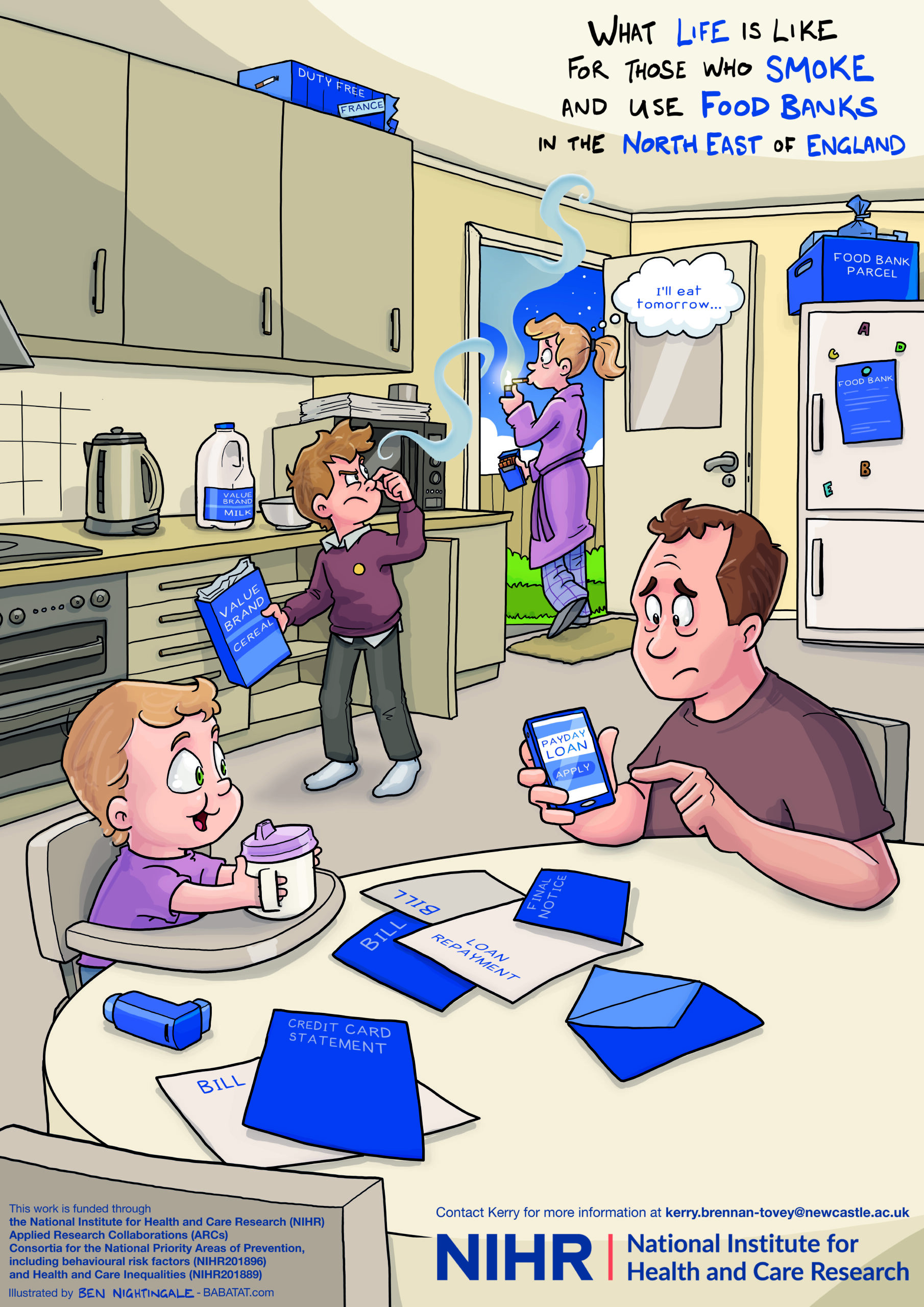
- Would budget their monthly or weekly income to ensure that they were able to pay their bills and purchase both food and tobacco. However, would report that they would purchase food from budget supermarkets, skip meals and use food aid organisations, and most reported purchasing illegal tobacco to ensure that they had enough.
- Were knowledgeable of the harms of tobacco use, reporting that they didn’t like the effects it had on their health (i.e., a cough or bad breath) or the smell, however they felt that using tobacco products helped reduce their stress and anxiety, and was seen as a ‘treat’, something that they did just for them. Many reported smoking at their back door or in the garden to eliminate the smell from their house.
We worked with our Public Advisory Group (PAG), made up of those with lived experience and community experts, to review all study materials prior to the study starting and to review our findings.
We conducted an in-person analysis workshop with our PAG to review themes and findings.
Our PAG were then involved in the development of our study graphic visual, below:
What’s next?
We plan to publish an academic journal article from this research which we hope will inform local policy and provide insight for academic partners.
More research is needed in this area to further understand the barriers to making a quit attempt and engaging with local smoking cessation services.
Update – October 2025
The findings from this study have now been published in BMJ Public Health.
Read a plain language summary of the findings
To find out more about this work, please contact:
Dr Kerry Brennan-Tovey at kerry.brennan-tovey@newcastle.ac.uk