
Researchers from Teesside University and the NIHR Applied Research Collaboration (ARC) North East and North Cumbria (NENC) are exploring how to support better balance and prevent falls in people with Chronic Obstructive Pulmonary Disease (COPD).
More than 1.2 million people in the UK live with COPD, which causes breathlessness, coughing and frequent chest infections. People with COPD are four times more likely to fall than healthy adults of the same age due to poor balance. As we age muscles become weaker and slower to react to unsteadiness, but symptoms and inactivity mean this happens more quickly in people with COPD.
However, physical changes are not the only reason people fall – social and environmental factors are also important, such as how much space someone might have at home, or what their daily routine looks like.
Pulmonary rehabilitation is the usual treatment for COPD, including 6 to 8 weeks of exercise and disease education to reduce breathlessness. Balance training is not normally included in this.
Professor Samantha Harrison from Teesside University and the NIHR Applied Research Collaboration (ARC) North East and North Cumbria (NENC) is leading a £1.1 million programme of work, funded by a National Institute for Health and Social Care (NIHR) Advanced Fellowship, to develop balance training for people with COPD.
The research programme, called ‘B-Pure’, involves NHS trusts from across the Durham and Tees Valley Alliance, academics from Newcastle, Northumbria and Manchester Metropolitan Universities, and members of Breathe Easy Darlington – a support group for people with chronic breathlessness.
Professor Harrison said: “Our interest in investigating balance and falls in people with COPD stems from many conversations with patients who describe falling and becoming unsteady on a daily basis – sharing experiences both in and out of the home, including colliding with door handles, falling down stairs, wobbling when turning to put a key in a lock, and swaying when getting up from a chair. We wanted to know if a balance training programme could help with this – and therefore help to improve the lives of people living with COPD.”
The project has three main elements:
- The first is to look at existing research around exercise programmes already delivered to people with COPD, and how that may or may not help with balance.
- The second, consists of two parts; the first involves testing the muscle strength, reactions times and balance of people with COPD and older adults without COPD to see if weaker muscles and slower reactions explain why balance is worse in those with COPD; the second involves spending time with people in their homes to understand what it is like to live with COPD and the challenges they face on a day-to-day basis.
- The third and final stage of the project is to develop a new balance training programme with patients and carers, health care professionals and those interested in physical activity promotion, which will then be trialled and evaluated to see if and how it helps to prevent falls.
Reviewing research to explore how exercise might improve balance
The first part of the work involved carrying out a detailed review of research already published around exercise and COPD, to explore how exercise and/or balance training could help to reduce falls in people with COPD.
The research team looked at over 30 studies which examined the impact of various interventions for people with COPD – either in addition to or separately from pulmonary rehabilitation. These interventions included targeted balance or falls-prevention training, neuromuscular stimulation, dance, singing, water-based exercise, whole-body vibration, tai chi, gait modification and other programmes which included family members.
The review found that when balance training was included as part of pulmonary rehabilitation, it seemed to be more beneficial than other forms of exercise but over all the evidence was weak
The research also showed that including behaviour change techniques to improve self-regulation, such as monitoring situations or thoughts or reducing negative emotions, seemed to improve the benefit of exercise on balance.
The findings from the review have now been published and have been translated into an engaging storyboard, so they’re easier to understand.
The storyboard was developed with members of the Breathe Easy Darlington group, and designed by Dr Rachel Thomas, Senior Lecturer in Comics, Graphic Novels and Sequential Art at Teesside University.
Gill, who is Chair of Breath Easy Darlington, said: “Our involvement with this project and Teesside University has had a tremendous impact on our group. We have definitely felt the benefit and have not only a brighter outlook but feel a good deal fitter.”
You can see the storyboard here.
You can read a plain language summary of the review findings, here.
Living with COPD on a day-to-day basis
As part of the second element of the project, the research team conducted home observations and interviews with people with COPD, to find out more about the day-to-day difficulties that people with COPD face.
The interviews revealed a wide range of challenges. Analysis is ongoing but so far, three key issues have been highlighted:
- Facing significant threats to their health, for example mould in the home, which can have an impact on breathing.
- Issues accessing opportunities to access health services/opportunities due to factors such as unsafe neighbourhoods and lack of transport.
- The ‘cost of coping’ – which includes the mental load of living with COPD, as well as the financial costs associated with it.
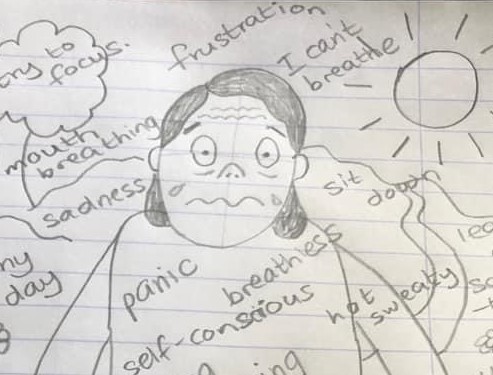
The research team worked with members of the Breathe Easy Darlington group and a graphic artist to develop a visual summary of the challenges – which offers a striking insight into what it is like to live with COPD.

You can view the infographic in more detail here.
NIHR ARC North East and North Cumbria Research Fellow Dr Sophie Suri, is supporting the project.
She said: “The infographic really captures the multiple, and often overwhelming, challenges that people living with COPD face daily. It is a busy graphic, depicting difficulties both inside and outside of the home, which patients often have little or no control over.
“We hope that this infographic helps to highlight the wider social and environmental factors that have an impact on those living with COPD and help health and care practitioners to see COPD through their patients’ eyes.”
Research Fellow Kirsti Loughran from Teesside University is also supporting the study. She added: “Seeing how people interact with their environment and talking to them about it offers a deep understanding of what life really is like with COPD.
“This gives us a better understanding of why going for a walk or exercising at home can be really difficult. We can now use this information to build an intervention that is much more accessible to those who really need it and that’s very exciting.”
Testing how and why balance is impaired
The second phase of the project has also included exploring how and why balance is impaired in people with COPD, compared to healthy people.
Twenty people with COPD and twenty people without COPD took part in a whole day of physical tests, undertaken in the clinical lab at Teesside University. This includes tests to determine muscle strength, reaction times, and balance.
The results will be presented at the British Thoracic Society winter meeting at the end of 2024.
Co-developing balance training
The team are now in the process of co-developing a balance training intervention, working closely with patients with COPD.
As part of this, 22 people with lived experience of lung disease, and 57 health professionals took part in co-creation workshops or completed an online survey.

Image: Participants discuss balance training needs
Workshop one focussed on understanding what people with lung disease want and need from balance training.
The key findings were:
- Falls are most common when people are changing position (e.g. standing up or getting out of bed), walking/moving around, when lifting, carrying or reaching for something, or on uneven ground.
- Top three physical priorities are being able to walk further, feeling more steady, and changing direction/turning more confidently.
- Top three social/emotional priorities are better quality of life, feeling more confident and better mental health.
- Top three practical priorities are affordable, convenient location and enjoyable.
- Most relatable/common challenges for people with COPD are finding it difficult to get places, feeling the need to plan life very carefully, and feeling left out from activities with friends/family.
- Most popular proposed activities are tai chi, walking football and dance. They were perceived to be safe, social, enjoyable, low cost, flexible and adaptable.
Workshop two focussed on the practicalities of delivering balance training.

Image: Participants explore a range of balance activities
The key findings were:
- The proposed walking sports activities were well received with many suggestions for modifications and additional components.
- Balance training should be a PR maintenance programme or a separate activity. There is no clear preference for who should be eligible to attend.
- The priorities for a balance training venue are good accessibility (parking, public transport etc) and a social space. The time should be late morning, lunchtime or mid-afternoon.
- The at-home part of the programme needs to be as easy and safe as possible.
- Tracking and goal setting is recognised as important, but there is no clear preferred method.
- Adding falls education, door-to-door transport, socialising and support for mental health would motivate participants to attend regularly.
- The balance training instructor could be a physio, or a sports coach provided they understand COPD, falls management, and how to modify activities for different abilities.
Summary reports have now been developed to share the workshop findings, which you can view here.
The research team are now using the insights from the workshops and surveys, to develop a randomised control trial comparing walking sports-based balance training, with standard care. This will be offered to people with COPD who have completed pulmonary rehabilitation (PR).
Once the balance training intervention has been developed, a trial will begin at the end of 2024 and run for 18-months.
If successful, the aim is that balance training will be included as a core component of clinical care for individuals with COPD.
You can read a summary of the overall project here.
Acknowledgements
Professor Samantha Harrison’s work is funded by an NIHR Advanced Fellowship. Professor Harrison is also Deputy Theme Lead of the NIHR ARC North East and North Cumbria’s ‘Integrating Physical Health, Mental Health and Social Care’ research theme.
Dr Sophie Suri is a Research Fellow funded by the NIHR ARC North East and North Cumbria.
Dr Kirsti Loughran is a Research Fellow funded by Teesside University and from the NIHR Advanced Fellowship.
The ‘Living with COPD in the real world’ graphic was developed by Nifty Fox Creative.